
Boycott
Why 'boycott' means expressing protest through non-violent abstention

During the Swadeshi Movement, Gandhiji took a pledge to boycott all foreign goods in India.
Ireland is a country with a long history in agriculture. It went through several periods of agrarian agitation during the late 19th and the early 20th centuries, because the majority of lands were owned by a few landlords for whom the Irish farmers worked as tenants. One such intense period of agitation happened between 1879 and 1882 which is know as the Land War. It was led by the Irish National Land League – an Irish political organization that sought to help poor tenant farmers – to abolish landlordism in Ireland and to enable the tenant farmers to own the land they worked on.
Lord Erne was one such landlord who owned more than 40,000 acres of land in Ireland! Out of this staggering number, around 2000 acres were in the County Mayo out of which 1500 acres was handled by Charles Boycott – one of Erne’s land agents. One of Boycott’s responsibilities was to collect rent from the tenant farmers which entitled him to ten percent of the proceeds that went to Erne.
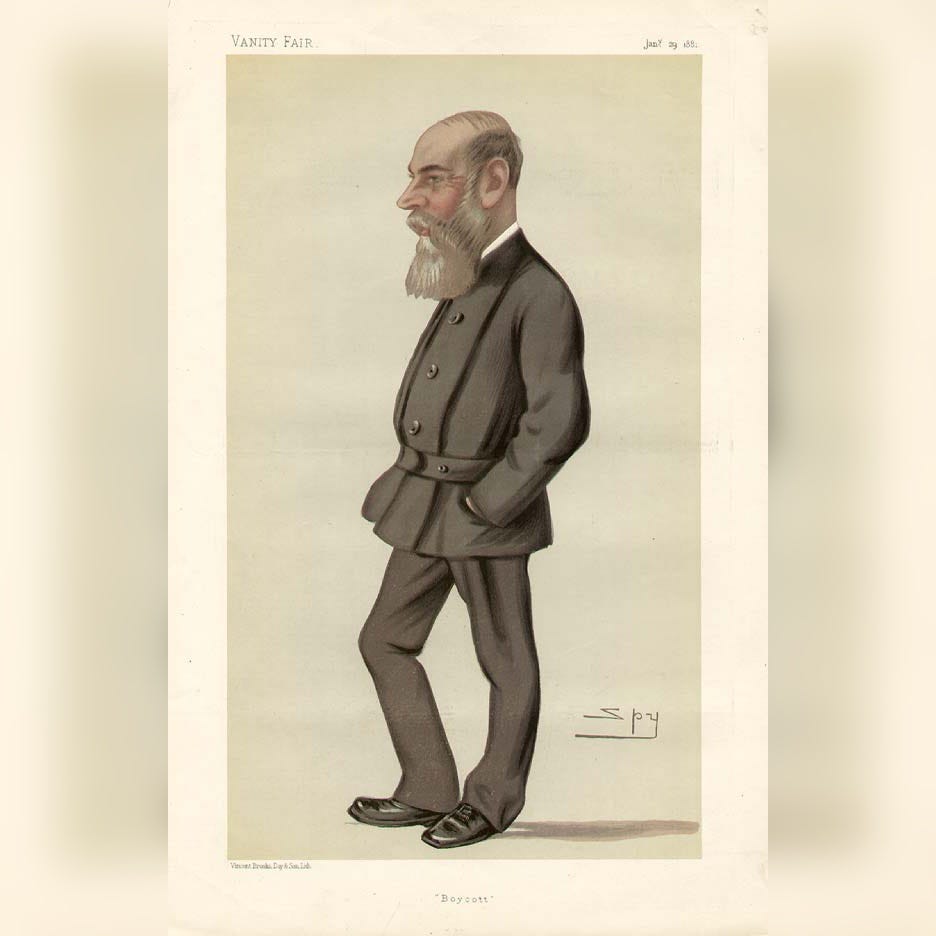
In 1880, during the Land War, since the harvests were particularly poor, Lord Erne offered the tenant farmers a ten percent reduction in rents. But the protesting farmers demanded a twenty-five percent reduction which he refused. Boycott tried expelling the tenants from the land. This made Charles Stewart Parnell, the president of the Land League, instruct the evicted tenant farmers to avoid other tenants who take farms in the the lands they were evicted from.
Although he did not refer to landlords or land agents in particular, this was first applied to Charles Boycott. Workers stopped working in the fields and his house, local businessmen stopped trading with him and local postman refused to deliver any mail. Boycott found himself isolated and unable to hire anyone to further to harvest the crops that he was in charge. This tactic successfully continued in other parts and the term boycott soon became popular everywhere.
Poor Boycott.
Thank you for reading. See you in the next issue of Wordly Origins.
—Salai Vedha Viradhan
Credits
Caricature of Charles Boycott – Wikimedia Commons
.jpg?uselang=en#Licensing)